How Do I Track Onboardings, Share Form Links and Run Business Setup in Kickcall?
Find Kickcall onboarding records, share form links, review history and time in stage, and run Business Setup after the required information is reviewed
Written By Maruf Ansari
Last updated 9 days ago
Without a single place to track onboardings, it's easy to lose track of which Business submitted the form, which one is stuck, and which link to re-share. All Onboardings & Actions is where every new Business onboarding lives — from the moment the form link is generated until the Business is fully set up and the AI agent is stable — so you can track status, share links, attach support tickets and run quick actions on every row.
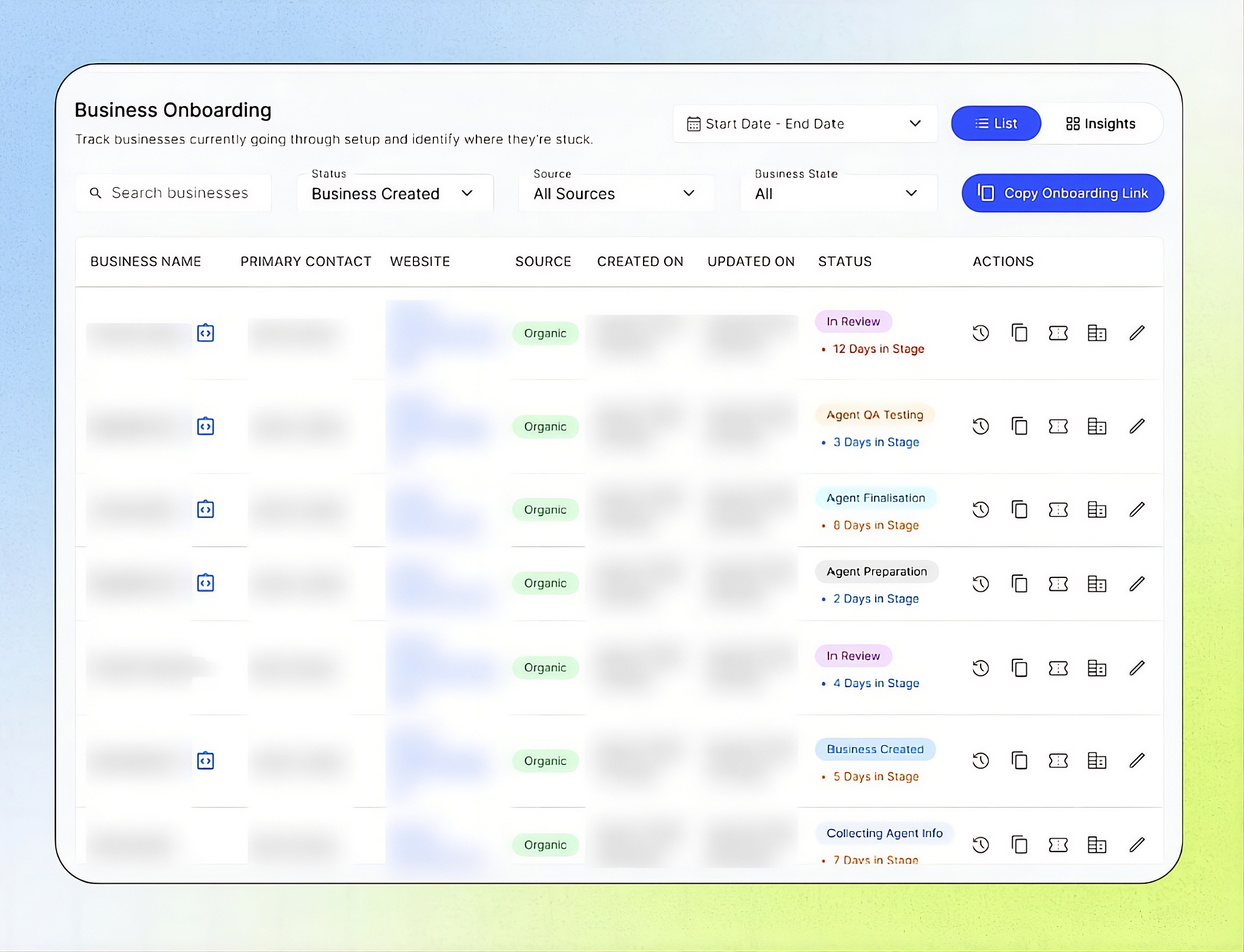
All Onboardings and Actions Overview
All Onboardings and Actions allows Agency administrators and team members to manage and track all Business onboardings in one place. You can generate and share onboarding form links, search and filter records by Business name, source, or status, and monitor progress through the onboarding pipeline. You can also review onboarding history, manage tickets, edit Business details, initiate Business Setup, and archive onboarding records. Reviewing and verifying information before Business Setup helps ensure accurate details are carried into the live Business Portal.
Important notes
We recommend letting the Business complete the Onboarding form first, end-to-end — doing internal configuration before that leads to duplicated work and mismatched data.
Archive hides a record from the default list but keeps its history, ticket references and audit events intact.
Before you start
Access to the Agency Portal's Onboarding module.
For Business Setup, the onboarding form must be 100% complete and reviewed first.
If you use a helpdesk such as Zendesk or Freshdesk, have the relevant ticket ID ready to attach.
Open the Onboarding module
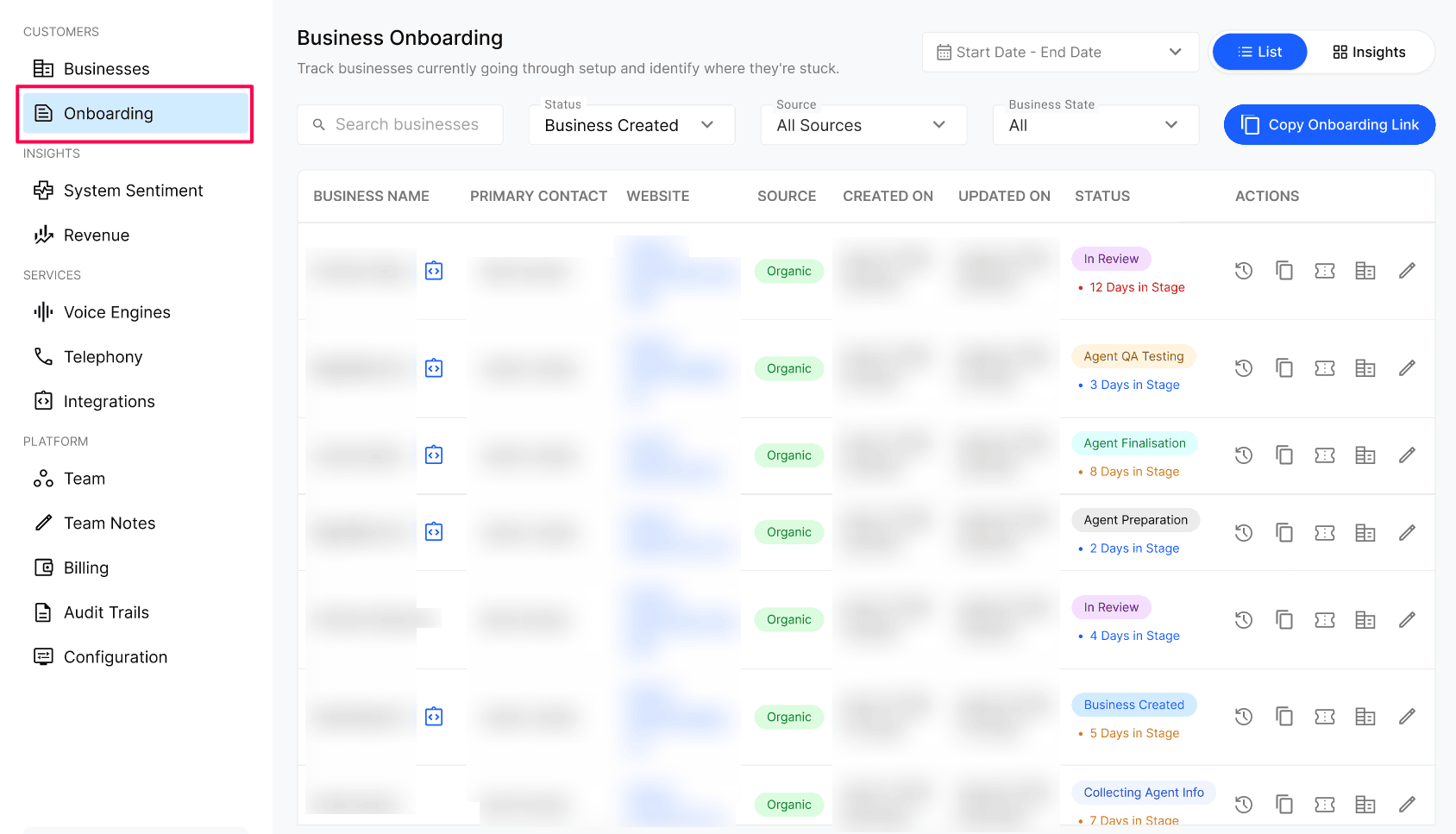
From the left sidebar of the Agency Portal, select Onboarding. You land on the Business Onboarding view — a table of every onboarding currently in progress or completed for your Agency.
Each row shows the following columns:
Business Name — the name captured in the onboarding form.
Primary Contact — the business owner or main point of contact.
Website — the business website URL.
Source — how the business came in (Organic or Referral).
Created On — the date the onboarding was created.
Updated On — the date and time of the most recent change to the onboarding record (for example, a form submission, status change, or Agency edit).
Status — current stage of the onboarding (see Onboarding Statuses for the full list). Below each status badge, a Days in Stage counter (for example, 12 Days in Stage) shows how long the onboarding has been sitting in its current status.
Actions — quick action icons (see Step 4).
Days in Stage
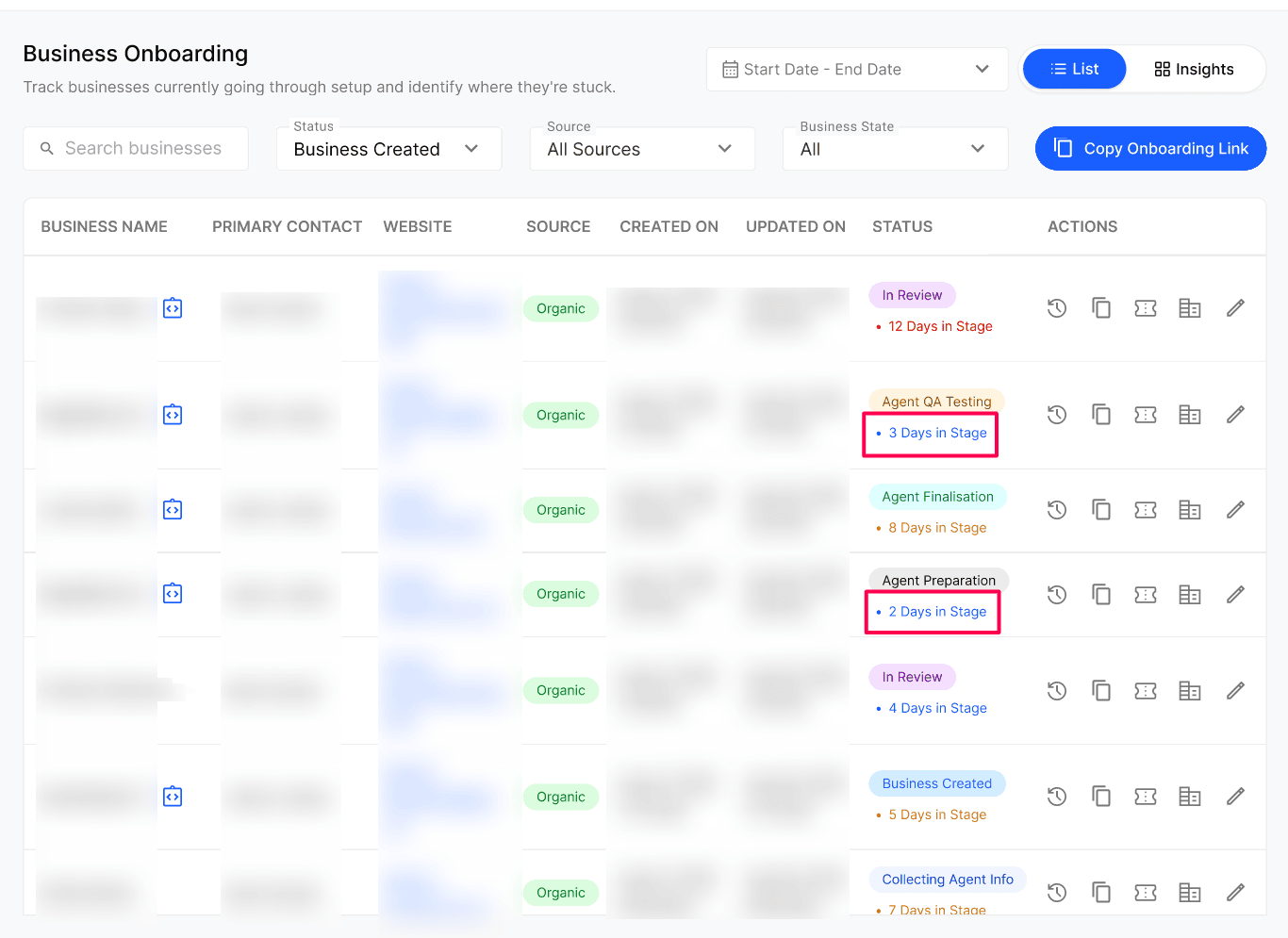
Every status badge has a small Days in Stage indicator underneath it. It counts the days since the onboarding moved into its current status, and it resets each time the status changes. The colour of the indicator helps you spot onboardings that are taking longer than expected:
Blue — recently moved into this stage; progress is on track.
Orange — the onboarding has been in this stage for a while and may need a nudge.
Red — the onboarding has been stuck in this stage for a long time and should be followed up as a priority.
Use this to prioritise follow-ups — for example, an onboarding showing In Review · 12 Days in Stage in red is a clear signal that your team needs to complete the review and move it to Business Setup.
Search and filter the list
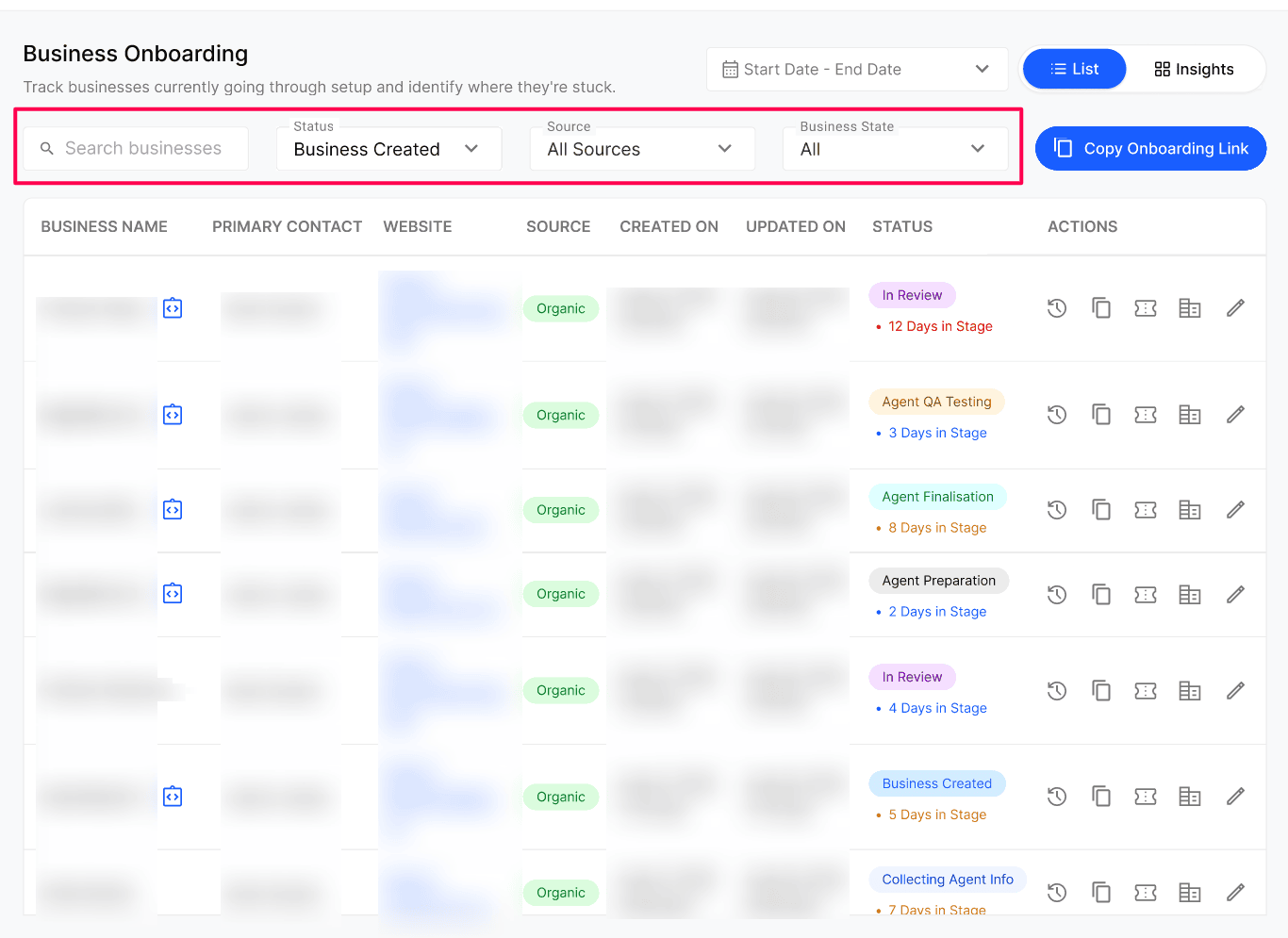
Use the Search business bar at the top to find an onboarding by business name.
Use the Source filter to narrow the list by where the business came from (Organic or Referral).
Use the Status filter to focus on a specific stage.
Copy Onboarding Link
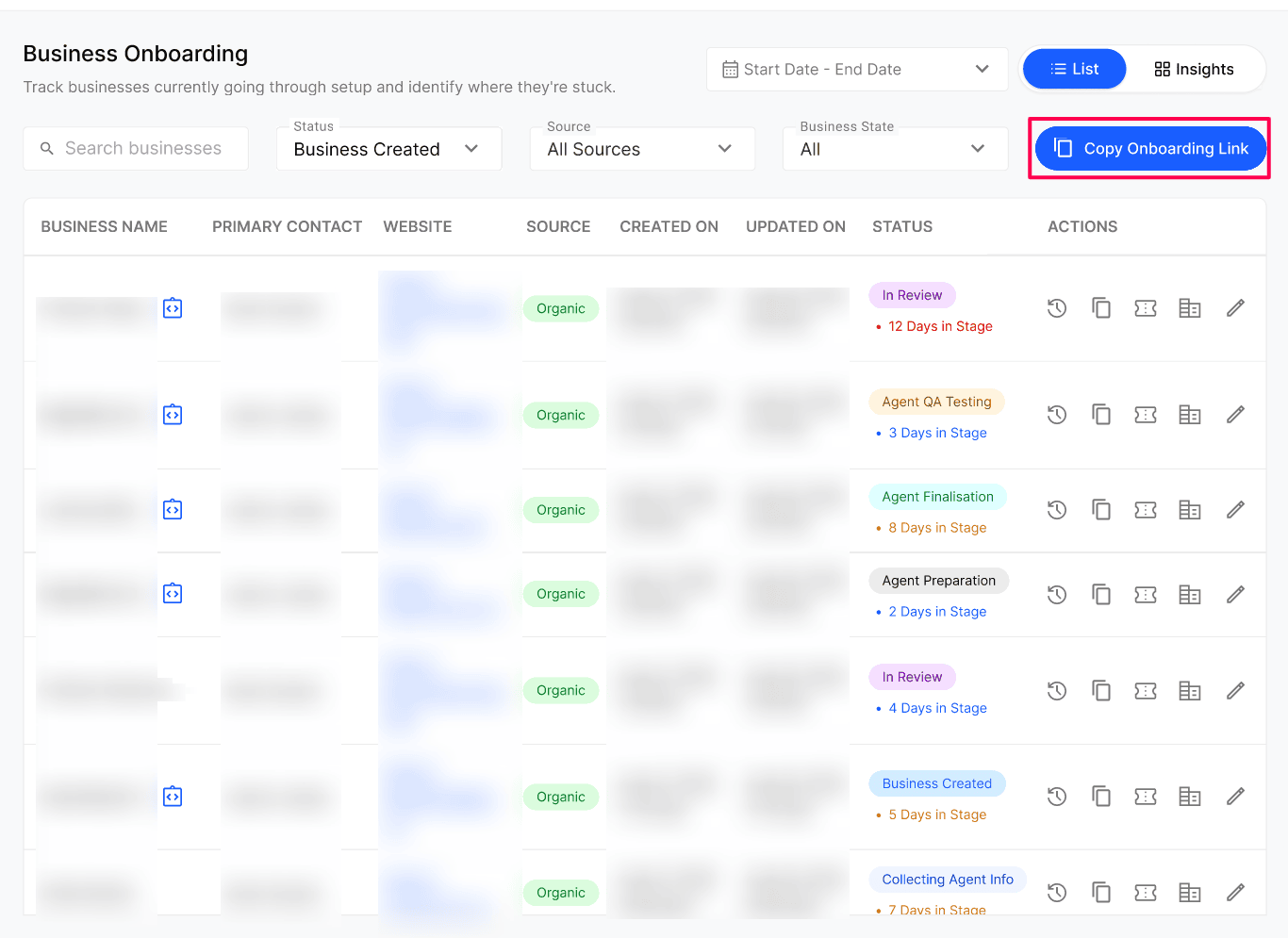
Select Copy Onboarding Link at the top right to generate a fresh onboarding entry and copy a unique Onboarding Form Link to your clipboard, ready to share with the new business owner. Everything captured through the form (business details, locations, owner details, telephony, billing package, and so on) flows directly into this onboarding record.
Recommended: Always use the Onboarding form for any live Business. It captures everything required for go-live and feeds directly into the Business Portal once Business Setup is completed.
Source: Organic vs Referral
The Source column tells you how the business landed in your onboarding pipeline:
Organic — the onboarding was started directly, without coming through a referral partner. This is the default source when you generate the link yourself or when the business signs up through your own channels.
Referral — the business came through a referral partner. Kickcall supports third-party referral integrations like Tolt; when a business arrives through one of those links, the onboarding is automatically tagged as Referral so you can attribute it correctly.
Row actions
Each row has six quick action icons on the right.
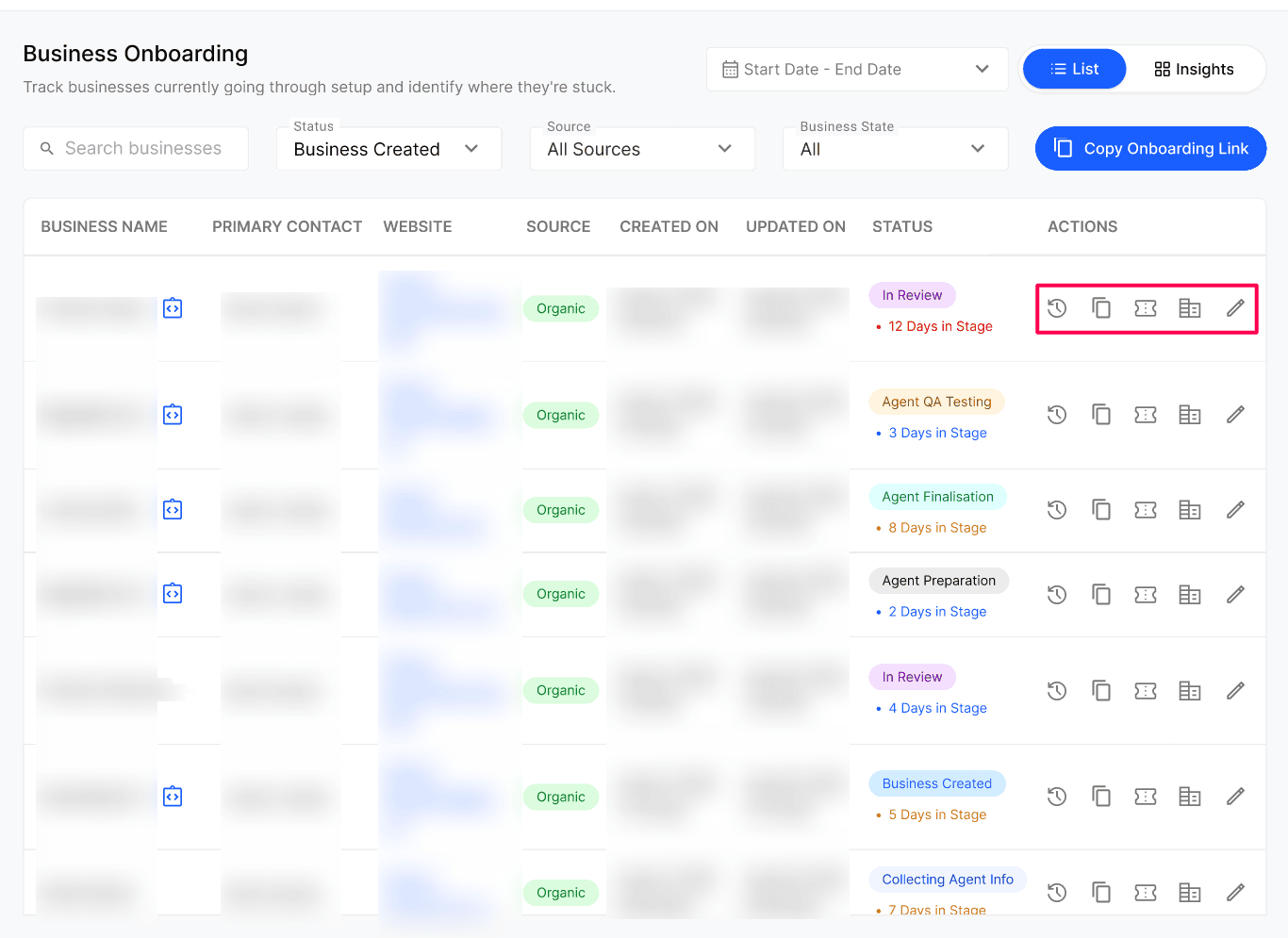
a. View History Log (clock icon)
Opens the full History Log for that onboarding — every change, status update, form submission, Agency edit and system event in chronological order. Use this to see who did what and when, and to troubleshoot anything the business owner reports.
b. Copy Form Link (copy icon)
Copies the unique Onboarding Form Link for an in-progress onboarding to your clipboard. This is a secure link tied to that specific Business — if the business owner misplaces their original email or didn't finish the form, you can re-share the same link so they pick up exactly where they left off.
c. Ticket Reference (ticket icon)
Attach or view a support ticket reference linked to this onboarding. Use this field to add the ticket ID from your own service portal — Zendesk, Freshdesk or any other helpdesk — so your team always has a single thread connecting the onboarding work and the support conversation with the Business.
d. Business Setup (form icon)
Opens the Business Setup screen for this onboarding. Once the onboarding form is 100% complete and all information has been reviewed and confirmed, you can create the Business in one click — Kickcall provisions the Business with all default setup (voice engine, telephony, billing package, knowledge base, locations) based on what was captured in the form. See Manage Business Details & Configurations for what gets configured at this step.
e. Edit (pencil icon)
Opens the onboarding record so you can edit the details captured in the form on behalf of the Business — for example fixing a typo in the business name, updating a contact email or correcting a website URL before pushing the onboarding through to Business Setup.
f. Archive (archive/box icon)
Archives the onboarding record so it is removed from the default list view. The record is not deleted — it is simply hidden from the active list to keep your workspace tidy. Use it for completed, cancelled or stale onboardings that no longer need front-and-center attention. History logs, ticket references and audit events remain intact.
Expected result
A new onboarding row appears in the list as soon as you copy an Onboarding Link, its Status and Days in Stage update as the Business and your team make progress, and completing Business Setup creates a corresponding record in the Businesses module.
Verify the result
After selecting Copy Onboarding Link, confirm a new row appears in the list with Status at its initial stage.
Share the link and ask the Business to submit the form, then confirm the row's Updated On timestamp changes and Status advances.
After running Business Setup, confirm the Business now appears in the Businesses module.
Troubleshooting
Recovery or rollback
Use Edit on the row to correct onboarding details before running Business Setup. If an onboarding was archived by mistake, locate it through search or filters — archiving does not delete any data.
Frequently Asked Questions
What's the difference between an Onboarding and a Business?
What's the difference between an Onboarding and a Business?
An Onboarding is the intake record — the form, the details collected and the agency-side setup work. Once Business Setup is completed, a Business is created in the Businesses module and goes live with its own portal, billing and configurations.
Can I re-share the form link if the business owner loses it?
Can I re-share the form link if the business owner loses it?
How does Source get set to Referral?
How does Source get set to Referral?
When a business arrives through a connected referral integration like Tolt, Kickcall automatically tags the onboarding as Referral. Anything else defaults to Organic.
Where do I add a Zendesk or Freshdesk ticket against this onboarding?
Where do I add a Zendesk or Freshdesk ticket against this onboarding?
Use the Ticket Reference action on the row to attach the ticket ID from your service portal. It keeps the helpdesk thread and the onboarding record linked.
What does "one-click Business Setup" actually do?
What does "one-click Business Setup" actually do?
It creates the live business using the data captured in the form and applies all default settings (voice engine, telephony, billing package, knowledge base, locations). After this point the business exists in the Businesses module and you fine-tune from there.
Where do I see who edited the onboarding details?
Where do I see who edited the onboarding details?
Open View History Log on the row — every edit (by the business owner via the form, or by your agency team via the Edit action) is recorded with the user and timestamp.
What counts as an update in the Updated On column?
What counts as an update in the Updated On column?
The Updated On timestamp changes whenever the onboarding record is modified — this includes form submissions by the business, status transitions, agency edits, ticket references, or any other saved change. It does not update for read-only actions such as copying the form link or viewing the history log.
What happens when I archive an onboarding?
What happens when I archive an onboarding?
Archived onboardings are hidden from the default Business Onboarding list but remain in the system. History logs, ticket references and any linked records are preserved, and you can still locate archived onboardings through search or filters.
Related articles
Was this helpful?
Still need help? Ask the team